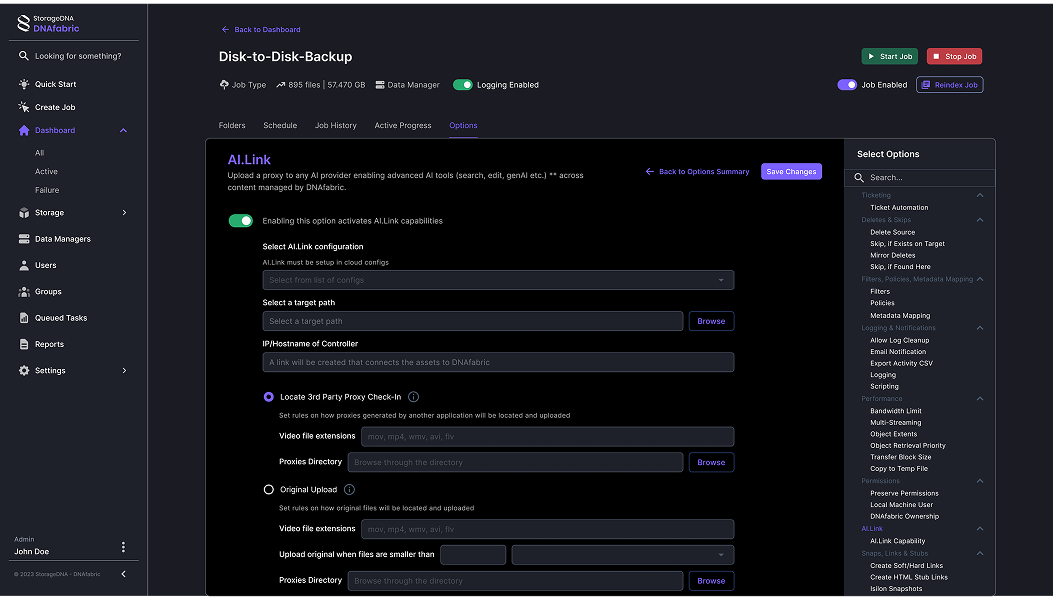




FrameIO has long been the collaboration platform of choice for post-production and media teams. With its recent introduction of Semantic Search, FrameIO has taken an important step toward helping users find content more intuitively across growing video libraries.
Semantic search allows users to mix traditional text queries with natural-language intent, making it easier to locate clips based on meaning rather than just filenames or manual tags. For many teams, this is a welcome and overdue improvement.
However, semantic search alone does not solve the deeper challenge facing modern media organizations: the lack of rich, multi-dimensional AI metadata behind the assets themselves.
The Hidden Limitation of Semantic Search
Semantic search is only as powerful as the metadata it operates on.
While FrameIO’s implementation enables smarter search across existing text and comments, it does not perform deep AI enrichment of video, audio, or image content. This means several critical dimensions remain unaddressed, including:
- Object detection
- On-screen text (OCR)
- Face and celebrity recognition
- Brand and logo detection
- Emotion and sentiment analysis
- Questionable or compliance-related content
As a result, users can ask better questions — but the system still lacks the underlying intelligence to answer many of them.
For example:
- “Find all scenes where a specific brand logo appears”
- “Show moments where a particular person appears and the crowd reacts positively”
- “Identify scenes that may require compliance review”
Without AI enrichment across these modalities, semantic search quickly hits a ceiling.
Why Media Teams Need More Than Search
Media organizations today are dealing with:
- Thousands of hours of video
- Multiple storage locations
- Tight review and approval timelines
- Increasing compliance and brand-safety requirements
Manual tagging and review simply don’t scale.
What teams actually need is AI-driven understanding of content, not just better indexing of what’s already known.
This is where DNAfabric comes in.
DNAfabric: The AI Enhancement Layer for FrameIO
DNAfabric is designed to extend FrameIO’s capabilities, not replace them.
While FrameIO remains the system of record for review and collaboration, DNAfabric acts as an external AI enrichment and action pipeline that adds deep intelligence to FrameIO assets.
DNAfabric enables organizations to enrich FrameIO assets using a multi-vendor AI strategy, integrating best-in-class AI services such as:
- AWS Rekognition
- Azure Video Indexer
- Azure Vision
- Google Cloud Vision
- Twelve Labs
By leveraging multiple AI endpoints across video, audio, and image modalities, DNAfabric ensures richer metadata, better accuracy, and no vendor lock-in.
Beyond Semantic: Multi-Modal AI Search Inside FrameIO
DNAfabric doesn’t just enrich assets — it makes that intelligence usable inside FrameIO.
AI-generated metadata is converted into:
- Summaries
- Tags
- Time-based events
- Searchable comments
Because comments are indexed by FrameIO’s semantic search, users can immediately search across AI-derived insights such as:
- Objects and scenes
- On-screen text
- Faces and celebrities
- Brands and logos
- Emotional cues
- Safety or compliance signals
This transforms FrameIO from a review tool into a multi-modal discovery platform.
How the DNAfabric AI Pipeline Works with FrameIO
DNAfabric integrates seamlessly into existing FrameIO workflows:
Step 1: Asset Ingestion
- DNAfabric can download assets already present in FrameIO (manual uploads, camera-to-cloud, deliveries).
- Alternatively, assets can be uploaded to FrameIO directly by DNAfabric, using either hi-res or AI-optimized lo-res proxies.
Step 2: AI Proxy Creation
- Assets are converted into vendor-specific proxies optimized for video, audio, and image analysis.
- This reduces cost, improves performance, and ensures compatibility across AI providers.
Step 3: Multi-Vendor AI Enrichment
- Proxies are submitted to one or more AI vendors in parallel.
- Metadata is extracted across multiple modalities and normalized into MeshDB, DNAfabric’s multi-modal metadata store.
Step 4: Re-Check-In to FrameIO
- Enriched metadata is summarized and written back into FrameIO as comments, tags, and events.
- All AI-generated insights become immediately searchable using FrameIO’s semantic search.
Extending AI Beyond FrameIO
While DNAfabric enhances assets within FrameIO, its capabilities are not limited to it.
The same AI pipelines can be applied across:
- NAS environments
- Cloud storage
- Object storage
- Archives and long-term media repositories
This enables organizations to build a single, unified AI intelligence layer across all media assets — regardless of where they live.
The Bigger Picture: FrameIO + DNAfabric
FrameIO provides the collaboration layer.
DNAfabric provides the intelligence layer.
Together, they enable:
- Faster discovery
- Smarter review workflows
- Reduced manual effort
- Improved compliance and brand safety
- Scalable AI adoption without vendor lock-in
Semantic search is a great starting point — but real AI value comes from enrichment, not just search.
See AI-Enriched FrameIO in Action
If your team is already using FrameIO and exploring semantic search, the next step is to see what’s possible when deep AI enrichment is added to the workflow.
Book a live demo to see how DNAfabric transforms FrameIO assets into searchable, intelligent media — without disrupting how your teams work.
If you’d like, next I can:
- SEO-optimize this for specific keywords
- Shorten it into a Google Ads landing page version
- Turn this into a technical whitepaper
Create a FrameIO vs FrameIO + DNAfabric comparison blog